READING WITH THE EARS
ELIZABETH LÓPEZ GARZÓN
Step 1 - Identifying a research problem and reviewing the literature related to research problem
STATEMENT OF THE PROBLEM
Audiobooks have been known as beneficial
learning tools for native speakers as an effective instructional intervention
for students with learning disabilities and in EFL as an attractive way to
support students’ reading development and independence since it is similar to
the classroom activity or strategy reading aloud (Imawan, 2019) The
implementation of audiobook at EFL classroom can positively result in a
significant reading comprehension for students´.
SIGNIFICANCE OF THE STUDY
Since classes are set in an online environment L2
learners are expected to go through their reading process with less synchronous
counseling than in a face to face learning seating for that reason, listening
from an audiobook is considered similar as read aloud by the teacher. Listening
audiobooks give enjoyment in reading and improve the quality of reading at the
same time.
SCOPE OF THE STUDY
Whilst the positive effects of audiobooks in listening comprehension have
been deeply evidenced, the impact on reading comprehension in virtual learning
students should be studied in a major level. As a result we could find students
feel more confident in front at their proficiency levels.
LITERATURE REVIEW
Assisted
Reading with Digital Audiobooks for Students with Reading Disabilities
Kelli J. Esteves, Ed.D. Butler University,
Indianapolis
Elizabeth
Whitten, Ph.D. Western Michigan University, Kalamazoo
The goal of this study was to compare
the efficacy of assisted reading with digital audiobooks with the traditional
practice of sustained silent reading (SSR) in terms of reading fluency and
reading attitude with upper elementary students with reading disabilities.
Treatment group participants selected authentic children’s literature and
engaged in assisted reading with digital audiobooks four to five times per week
over an eight-week implementation period. Results showed that while all
students demonstrated growth in reading fluency as calculated by words read
correctly per minute, the growth of the treatment group far outweighed that of
the control group. There was no significant difference in reading attitude
scores. Consequently, this study shows that teachers can promote greater growth
in reading fluency when assisted reading with digital audiobooks is implemented
in the place of SSR.
Teaching
Reading Comprehension in English in a Distance Web-Based
Course:
New Roles for Teachers
Jorge Hugo Muñoz
Marín
Adriana González
Moncada
Universidad de
Antioquia, Colombia
Distance web-based learning is a popular
strategy in ELT teaching in Colombia. Despite of the growth of experiences,
there are very few studies regarding teachers' participation in these courses.
This paper reports preliminary findings of an on-going study aiming at
exploring the roles that a teacher plays in an efl reading comprehension
distance web-based course. Data analysis suggests that teachers play new roles
solving technical problems, providing immediate feedback, interacting with
students in a non traditional way, providing time management advice, and acting
as a constant motivator. The authors conclude that efl teachers require
training for this new teaching roles and the analysis of web-based distance
learning environments as an option under permanent construction that requires
their active participation.
Using
Audiobook to Teach Reading Comprehension Narrative Text for Tenth Graders of
Senior High School
Rista
Ayu Melani English Department, Faculty of Language and Art, State University of
Surabaya
Reading has been an important skill for
foreign language students to learn in English language. However, many
difficulties that experienced by foreign students to learn to read English,
especially reading comprehension. Therefore, media is needed to support
students and teacher in teaching and learning reading comprehension in the
classroom. Audio media can help students who experience difficulties in
understanding texts such as audiobooks. In this case, this study was conducted
to find out how the implementation of audiobook media as a tool to help
students in understanding in reading a text, how to implement this media in the
classroom and how the students’ responses after using audiobook. Researchers of
this research focus on narrative text as material in the use of audiobooks.
Furthermore, this study uses teachers and students at tenth grades for research
subjects in the implementation of audiobooks for reading comprehension in
narrative texts. This study uses descriptive qualitative to get the results of
a study, where researchers conduct observations and interviews with the
subject. Then, the results of this study indicate that in the process of
implementing audiobooks it is very easy to implement in the classroom. Then,
the results of student work show that almost all students can understand the
context in the text when using audiobook and get a good score. Whereas, in the
interview results almost all students showed comfort in using audiobooks and
was able to comprehend more narrative text.
TEMPLATE 2
Unit 2: Second
Activity – To specify a Purpose for Research and collect Data
1. The purpose of your research:
|
First paragraph: The purpose of this study is to find how students can feel more
confident in front at their proficiency in reading since audiobooks have a
positive result in improving the quality of reading by themselves through the
use of audiobooks because when students read and listen at the same time at
the end they have a better understanding of the language. |
|
Second paragraph: Moreover,
this action research allows teachers to inquire about how the material used
for this study can foster the extensive reading in the university community
and set a guide where students can find themselves reading in a better way
after the proposed exercises. |
2. Research questions:
You must write two (2) research questions; i.e.:
|
How the use of audiobooks can
foster the extensive reading in the university community? |
|
How the use of audiobooks and
the extensive reading can be used in the development of reading skills? |
3. Collecting Data
Link
https://forms.gle/93QmLLMa3fEaDWw57
|
TEACHING READING This questionary asks about your personal experience
about how foreign language students improve their reading skills.
Bio Data Please answer according to your own information
Years of experience _________________ Type of place you teach at
Public School Private School Institución para el Trabajo y el Desarrollo Humano University Teaching Reading Describe statements about how Foreign Language
Students learn how to read. Indicate your agreement or disagreement with the
following statements by choosing your response using this scale: It is more important to teach speaking and listening
before reading 1 2 3 4 5 Students tend to retain and comprehend more
information when this is provided through texts than listening to it. 1 2 3 4 5 Enjoyment has a strong correlation to reading
abilities increasing 1 2 3 4 5 Intensive reading is the most used type of reading
applied in the classroom 1 2 3 4 5 A strong reading ability is a pre-requirement or a
requirement for success in secondary and post-secondary schools. 1 2 3 4 5 Teaching reading
Think about your English classes and how you promote
reading in them. Do you promote reading in your classes? Yes No Have you had problems making your students focus on
reading? Yes No Have you used audio based reading programs in your
classes? Yes No Do you consider audiobooks can be helpful to support
reading classes? Yes No Is it easy to get students to enjoy reading? Yes No How do you teach reading? ______________________________________________
|
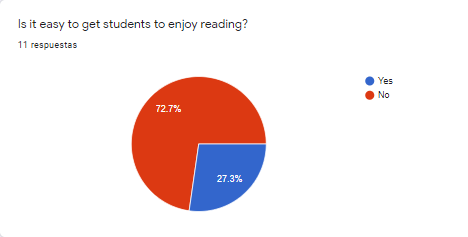
According
to the results provided by the previous survey teacher consider it is not easy
to get students to enjoy reading and it could find their reasons in the fact
that for 27.3% of teachers it is most important to teach speaking or listening
letting reading behind.

TEMPLATE 3
Unit 3 : Third
Activity – To analyze and interpret the Data
1. Analyzing and
Interpreting the Data
This
research belongs to qualitative method because it occurs in the classroom and
questions look for understand a person´s social environment in this case
teachers. The development of the present research tool was intended to know how
teachers personal experience was when teaching foreign language students to
learn and improve their reading skills in order to understand how feasible
extensive reading through audiobooks could be.
RESULTS
|
Thirteen teachers were asked
about their experience when teaching reading in English as a foreign language
and these are the results obtained from them.
Sixty-nine per cent of the
teachers who answer this questionnaire had five or more than five years of
experience which allows us to trust in their experience teaching English in
different fields as Instituciones para
el trabajo y el Desarrollo humano and schools.
The first question in the
questionnaire pretended to have an overview of the teachers’ experience
around what skill they considered more important to teach first. This pie
chart shows the amount of teachers who consider teaching speaking and
listening to English more important than reading.
 For 53,9% of teachers it is
more important to teach speaking and listening before reading nevertheless
when they are asked about the importance of reading in academic processes
they recognize how important this ability could be.
 As you can see 60,3 % of the
participants in this research recognize reading as an important skill in the
students’ success along their academic path.
In the second part of the
questionnaire teachers were asked about how they teach reading and the
problems they have promoting reading and the tools they consider useful to
achieve this.
First of all, more than 80 per
cent of the teachers have problems promoting reading and making their
students focus on reading and a big number consider enjoyment has a strong
correlation between reading and the increasing of this skill.


 Teachers understand enjoyment
helps students to increase their reading abilities but it is not easy for
them to get their students interest in reading, at least 76% of the teachers
in this research considered it was not an easy task.  As part of this analysis teachers’
were also asked about how they teach English in their classrooms and if they
have used audiobooks in their classes, finding that audiobooks or audio
support is used only when teachers have the time to promote them otherwise
they suggest them as homework or extra activity.

|
CONCLUSION
It is interesting to find that teachers
consider reading as an important part of the academic development of a student
but they are not teaching how to read in their classes, it is commonly an extra
task or homework.
The implementation of audiobooks in the
classroom could be an excellent way to promote reading in those situations
where there is no time during the class because this media can help students to
enhance their reading by themselves and also engage and enjoy this learning
process as they can understand the main idea of the content by listening to a
model.
DISCUSSION
Based on the previous analysis
the researcher can conclude that audiobooks are suitable media not only for the
teachers who consider they have no time enough to read during the classes, but
also for those who think listening should be taught before reading, because
here both skills can be used together as media learning in classroom or at
home.
REFERENCES
Imawan, M. R. (2019). (Journal of
English Language Teaching and Linguistics. Retrieved from https://core.ac.uk/download/pdf/297688732.pdf
Rista Ayu, M., 2018. RETAIN.
[online] Core.ac.uk. Available at: https://core.ac.uk/download/pdf/230779456.pdf
Esteves, K. J., & Whitten, E.
(2011). Assisted Reading with Digital Audiobooks for Students with Reading
Disabilities. Reading Horizons: A Journal of Literacy and Language Arts, 51
(1). Retrieved from https://scholarworks.wmich.edu/reading_horizons/vol51/iss1/4
Muñoz Marín, Jorge Hugo, &
González Moncada, Adriana. (2010). Teaching Reading Comprehension in English in
a Distance Web-Based Course: New Roles for Teachers. Profile Issues in
Teachers` Professional Development, 12(2), 69-85. Retrieved February 14,
2021, from
http://www.scielo.org.co/scielo.php?script=sci_arttext&pid=S1657-07902010000200005&lng=en&tlng=en.


Comentarios
Publicar un comentario