DIEGO ANDRÉS ROZO VEGA
TEMPLATE 1
Student’s Name: Diego Andrés Rozo Vega
Collaborative group #: 551027_4
Initial: First Activity – To identify a Research Problem and review the Literature
1. Identifying a Research Problem:
1. The disruptions caused by at-risk students in an English classrooms as escolar failure.
2. afterwards, then you had stated your research problem, you must develop the following aspects completing this:
• You must specify your research problem in one (1) paragraph:
|
There are many interruptions in the classroom-based naturally in external aspects like spontaneous visits, natural environments, or something important that caused the teacher leaving the classroom, but something more detailed in the English teaching process is the disruption caused by the students, one of them is the lack attention of the class, the inappropriate chatting while the class is in course or reject the teacher´s method and authority with the school´s goals when they think that teacher is incompetent.
|
• You must justify it in one (1) paragraph.
|
The lack of importance when the disruption emanates from the student, the risk of what the school can permit blandly, there are several aspects where the students develop rules of conduct and sarcastic attentions ending in scholar failure, Santos and Dominguez (2015) points out that is considered scholar failure when the student does not achieve the goals planted for the age and level of education. (pg.3).
|
• You must describe the need to study it in one (1) paragraph.
|
I consider that this problem is important to study, because disruption in English teaching in classroom officially divert the teaching, derived of the external and internal behaviours, why and how this behaviours appear in an educative context where the environment is to study, to raise awareness a new change in their lives and generate a significant interaction effect with the world.
|
2. Reviewing the Literature
You must write at least the abstracts of three (3) or more authors related to topic to research:
|
|
|
Thiel , Böhnke , Barth & Ophardt (2020) Social order in the classroom can be threatened in different ways. Effective intervention requires teachers to be able to assess very quickly what type of disruptive behaviour they are confronted with and how serious this disruptive behaviour is.(pg.4).To address this need, we decided to develop a video-based training module that fosters preservice teachers’ skills in noticing, reasoning, and generating strategies to deal with disruptions in the classroom. (pg.2). Preservice teachers can be effectively prepared for preventing and dealing with disruptions through the use of video-based learning arrangements in university classes.(pg.10).
|
References:
. Marion Scherzinger Alexander Wettstein. Springer Nature B.V. 2018 Classroom disruptions, the teacher–student relationship and classroom management from the perspective of teachers, students and external observers: a multimethod approach.
. Jurado de los Santos P, Justiniano Domínguez MD. Las conductas disruptivas y los procesos de intervención en la educación secundaria obligatoria. bol.redipe [Internet]. 27 de diciembre de 2017 [citado 15 de febrero de 2021];4(12):26-3. Disponible en: https://revista.redipe.org/index.php/1/article/view/302
. Felicitas Thiel , Anja Böhnke , Victoria L. Barth & Diemut Ophardt (2020): How to prepare preservice teachers to deal with disruptions in the classroom? Differential effects of learning with functional and dysfunctional video scenarios, Professional Development in Education. https://doi.org/10.1080/19415257.2020.1763433
TEMPLATE 2
Student’s Name: Diego Andrés Rozo Vega
Collaborative group #: 551027_4
Unit 2: Second Activity – To specify a Purpose for Research and collect Data
1. The purpose of your research:
|
First paragraph: This research has an important aspect about the behaviours inside a classroom environment, in this case I go back in 15 years at an English Institute called Instituto Británico, located in Soacha Cundinamarca, where the group were 25 students, all of them boys and girls with none English level but with a special characteristic, the inappropriate chatting as a disruption in class. Now the purpose is to determine the factors that have an impact on the teaching, retrieving events to tackle inside the problematic, researching the forbidden actions, aptitudes, attitudes and responses. We get in mind that exist extend ways in which classroom disruptions gradually appear but, the effects in the perspective of the teachers inside this problematic, tender to alter the course in the teaching schemes. Thiel, Böhnke, L. Barth & Ophardt (2020) state about the strategies that teachers use in the classroom depend heavily on what they notice and how they judge what they notice.
|
|
Second paragraph: There are many characteristics where disruption in classroom increase day by day, the objective is to visualise the student´s behaviours and opinions in order to create a stage to give statements supported under qualitative or quantitative methods but, whether the context or conditions allow it. Nevertheless is to give information based in evidence to promote changes in the learning strategies reflecting a pedagogical study which will enhance the special condition in an English class.
|
2. Research questions:
|
First question: What is the cause that generate the inappropriate chatting while the English class is in course?
|
|
Second question: Does exist a lack attention by the English teachers with the student’s requirements that impulse the disruptions in class?
|
3. Collecting Data
Survey Link: https://forms.gle/SrmdcZYFfadts22d8
1. Do you believe that disruptions such as inappropriate chatting are caused by the environment classroom? (School desk, lighting, temperature, walls colour, etc.).
Yes______
Not______
2. If your answer was yes, could you select the cause which determines this inappropriate behaviour?
- School desk
-
Lighting
- Temperature
- Colour walls
- Whiteboard
- Floor
- Dirty place
- All
others3. The following strategies could stop the disruption in class?
- Look away
- Stare at the chatting
- Catch by surprise
- Asking about the topic
- Retire them from the classroom
- To continue with the explanation
None.
4. Have you got a system or do you know about to stop a disruption in class?
Justify your answer.
5. Do you consider the social context (social stratum, problematic) as the basis of the students feel the confidence to disrupt an English class? Why?
Yes______
No_______
6. Do you think the English language must be teaching in virtual environments to stay away from inappropriate chatting? Why?
Yes________
Not _______
Why? ____________________________________________________
7. Do you think the disruption in class especially in English subject is an answer of learning difficulties?
Yes____
No_____
8. According to González (2010) the overall learning problems depend on a high level of characteristics, goals, and objectives of the school, proposed by the curriculum program for each course and the type of scholar maturity demand or the intellectual development level of children. Do you consider this information is related to the disruption in class where the students show this behaviour?
Yes____
No_____
9. Do you consider this behaviour is a problem or a process that could be addressed with a teaching strategy? Which of them do you consider?
- Problem
- Process
- None
- Other
10. Do you consider inappropriate chatting is an alternative to enhance free speech and freedom? Why?
Yes_______
Not______
Why__________________________________________________
|
Link Answer Sheet https://docs.google.com/spreadsheets/d/1aX8s8cZ5GnT4xmGT2t9ZN28BSe3iGkJPgeq8VjNgUPI/edit?usp=sharing
|
References:
Manual_Estilos_de_Aprendizaje_2004
González, Sandra. (2010). Dificultades de aprendizaje escolar. Fundación Valle de Lili.
Extraído de: http://bibliotecadigital.icesi.edu.co/biblioteca_digital/handle/10906/4476.
TEMPLATE 3
Student’s Name: Diego Andrés Rozo Vega
Collaborative group #: 551027_4
Unit 3: Third Activity – To analyze and interpret the Data
1. Analyzing and Interpreting the Data
Analyzing and interpreting the data involves drawing conclusions about it; representing it in tables, figures, and pictures to summarize it; and explaining the conclusions in words to provide answers to your research questions and purpose according to your applied survey.
You can follow this example from “Improving English Language Speaking Skills of Ajloun National University Students”, authors Samer Al Zoubi and Fadi Maher Saleh Al-Khasawneh (2016):Results Related to the First Question:
Do you believe that disruptions in class such as inappropriate chatting are caused by the environment classroom? (School desk, lighting, temperature, walls colour, etc.).
The answers in these questions reflect that the majority (11 people) agrees with the cause about the environment classroom exposed above.
The remaining people (2) disagree.
Inappropriate chatting is a factor caused by the environment classroom.

In the second question which is related to the first one, If your answer was yes, could you select the cause which determines this inappropriate behaviour? There were some options include like
- School desk
- Lighting
- Temperature
- Colour walls
- Whiteboard
- Floor
- Dirty place
- All
- others _______
The answers were determinant because the 38,5% chose all, they felt identified by this option, these factors stimulate the cause of the inappropriate chatting, but there are other groups with 30% where the opinion was the dirty place and school desk, I think these elements have been the cause of this problem. Exist 7.7% which had some answers in others such as the values of the students and teacher management, uninterested topic disengagement from class. These answers are important because are analysing the class background in its development.

In the third question, the following strategies could stop the disruption in class? I get the 61,5 % who chose to ask about the topic, it´s common to stop this problem, but another resource was chosen caught by surprise, here the evidence says that the probability is a kind of rule that all teacher has before asking about the topic.

So there were people who feel that is better to retire them from the class and other chose none, (here was a mistake by no leave a why question).
Continuing with the fourth question. Have you got a system or do you
know about to stop a disruption in class?
The major part of the people polled says that is better use new materials, diversify the class and became more interesting, these kind of opinions are a reflection of new change, the old teaching is disappearing and now with the new resources with the technology can face this behaviour, the inappropriate chatting.
The fifth questions. Do you consider the social context (social stratum, problematic) as the basis of the students feel the confidence to disrupt an English class? Why?


They used different answers focused on the class development and the teacher´s attitude, the major answer was not, the inappropriate chatting is centred in the classroom and how the teacher moves the class.
The sixth question. Do you think the English language must be teaching in virtual environments to stay away from inappropriate chatting? Why?


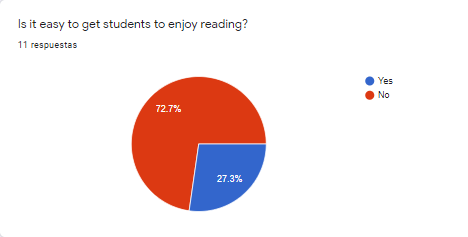
The seventh question. Do you think the disruption in class especially in English subject is an answer to learning difficulties?
The 61% (8 participants) affirm yes and the rest 38% (5 participants) said no, which summarizes of the questions above.

The last three questions are related whit the student´s behaviour, the answers are gathered in the school program, curriculum, process strategy, and the appropriated teaching neither to be permissible nor negligence in the student´s behaviour.
According to González (2010) the overall learning problems depend on a high level of characteristics, goals, and objectives of the school, proposed by the curriculum program for each course and the type of scholar maturity demand or the intellectual development level of children. Do you consider this information is related to the disruption in class where the students show this behaviour?

Do you consider this behaviour is a problem or a process that could be addressed with a teaching strategy? Which of them do you consider?

In this answer the participants agree with the process, the process is investigative, if the teacher applies pedagogical resources to find the solution he/she is working with the process class, I think this process must be worked with the curriculum mixed with the social context, so in this form, the teacher is working to innovate the Institutional educative project or (PEI).
Do you consider inappropriate chatting is an alternative to enhance free speech and freedom? Why?

Finally in this question, the people agree with the No answer in 46% and the 23% yes. Nowadays there is a contradiction between free speech and freedom with respect and tolerance in the class, both teacher and student could be affected if these actions are presented. I think that the best way is to enrich the respect and the use of the student handbook, but all is a process and strategies must be used to avoid this problem.
CONCLUSION.
Finally, the disruption in class with the inappropriate chatting is a researching process, the factors are implied in behaviourism, but the answers were cited in the environment and the teaching styles. I think in an English class is variated the teaching strategies, we know that no all the students love this subject but this situation since the first problem suggested is located in a school, could be another factor in different context like institutions, bilingual schools, universities, and so on; so, here there are many alternatives to give solutions but not all are effective with the students, each student is an independent world.
Here the conclusion is so far devoted to behaviourism, we can enter in extensive ways to inquired into each situation, this problem can be addressed in strategies but not in punishments. Dunbar (2004) states that a consequence should make sense, be a logical ending for an action. It should be the effect of behaving inappropriately. Punishment, on the other hand, is punitive and/or penal in nature. It does not necessarily serve a learning purpose, but rather “gets even.” It sends the wrong message. (Pg. 4).
DISCUSSION (1 PARAGRAPH)
I think each answer have an importance in the study of this researched process, the problem is not indifferent to us, each one had lived with it in distinct situations or scenarios, but in my opinion, I agree with the change of teaching strategies, the answers said that a good educational environment is managed with the strategies, the question is what kind of strategy is effective in X scenario?
Teachers must be investigative, a pedagogue who research, analyze, and give solutions in hard situations. This research template had taught me how are the perspective of each people, (teachers, housekeepers, and students) they have something in common, the teaching must be unpredictable, the strategies must change in each class and the respect and love for English subject will increase day by day.
References:
- Dunbar, C. (2004). Best Practices in Classroom Management. Retrieved from https://msu.edu/~dunbarc/dunbar3.pdf
- https://docs.google.com/forms/d/1POd1DQavw74lT_u80BmTw2cgCpR_8c6Z0-_2E5BQMR4/edit#responses
- Bhatia, M. (2018). Your Guide to Qualitative and Quantitative Data Analyzing and Interpreting the Data Analysis Methods. Humans of Data. Retrieved from https://humansofdata.atlan.com/2018/09/qualitative-quantitative-data-analysis-methods/


Comentarios
Publicar un comentario